Showing posts with label Pulitzer Winner. Show all posts

Thursday, 19 November 2020

Fences -August Wilson ( play script) 1985 / Fences- Denzel Washington ( Director) 2016

 August Wilson, The Theater Poet of Black America.

I now learn, that he was best known for a series of plays called The Pittsburg Cycle, or the Centenary Cycle, with each play aimed at presenting one decade of Black experience of the 20th century. He won the Pulitzer award for drama twice, once for the Piano Lesson  (1987), and Fences ( 1985). Fences aims to represent the 1950s, an era when the new black generation was becoming more hopeful, for a better life. We see that in the person of Cory, aspiring for greater things, only to be dampened to some level by his bitter father Troy, who still believed that the whites didn't give the black man a fair chance. But the whole mood of the play, other than with Troy, suggested that the times were changing for the better, for the black man. Troy himself should've recognized that, for he was able to present his case, and get a promotion as a driver, instead of a "lifter".

In a sense Troy is mix of his own brute of a  father for whom he had no sympathy, the bitterness of being denied to play the major league ( the racial barrier had not broken through in his heyday of playing the negro league baseball ), and in his own insecure way to protect his loved ones, namely his son, Cory, from the hurt that he endured by denied success at the highest level. Through his rigidity, his son loses an opportunity to go to college and play football. Even his elder son Lyon, wayward he may be, aspires to do what he likes by way of being a musician - and not toil over for years doing something that he doesn't enjoy, just so that that he can make a living.

Troy is convinced that he gives all he got for his family, and he is not sensitive to the fact that he takes a toll on his family too - especially his son, Cory, for not allowing to live the way that he wants. Cory, thinks it is a matter of his father denying him opportunities, whereas it is possibly Tory's fixed mindedness about how correct he reads the situation, and the ghosts of own father visiting him, on how he managed his children.

CORY: Just cause you didn't have a chance! You just  scared I'm gonna be better than you, that's all.

I felt, that Tory's own betrayal to his wife was over his attempt to vent his pressure - a pressure that he had set upon himself , mostly - through a moment of forgetting life's pressures. 

As a play script, it was most complete, catching most nuances in everyday life with an apt sentence or two.
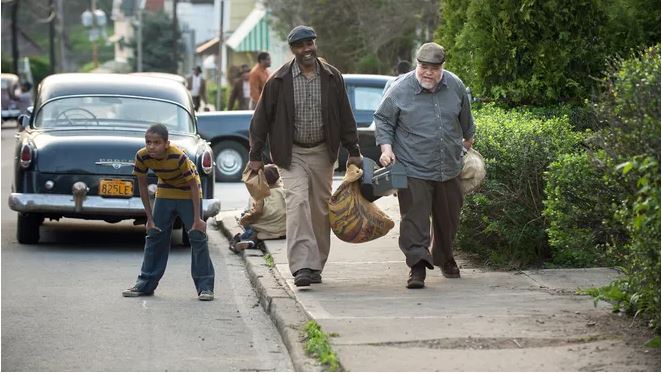


The movie: There are few differences between the play script and the movie.  For example, the episode where Rose asks Tory to come back home direct after work, a suggestion which infers that he give up Alberta for good, happens on the exit of Tory's workplace, with Rose coming to meet him there. In the  play it happens at the Maxson house. Some of the script is edited out in the movie. Despite the few added changes of scenes, the feel of a play sticks since it mostly dialogue which runs the movie, and the scenes are few - and they happen mostly on Maxson back yard, or in their house. DW has attempted to give it a more cinematic feel by adding different scenes to where the dialogues take place (e.g. above referred scene; Tory and Bono meeting at a pub, a few scenes where Tory feeds Gabe at the hospital etc., but the feel of the play has stuck. I didn't feel it in a negative sense though. 

Denzel Washington gives out true life representation of a black man accepting his lot  in the 1950s, up to each of his facial expression. The rest of the cast compliments him, and the movie is a wonderful, complete work of art. The sole reason for me to start reading the play script was upon my first viewing of the movie, and the recognition that it contains nuances as I've attempted to highlight above, which are best captured in a close reading than on a movie.

Genre - Play ( Script) ( 1985)
Rating - ***** 

Sunday, 17 December 2017

The Underground Railroad - Colin Whitehead

( Pulitzer Award for Fiction, 2017 )


"I saw cotton
and I saw 'bacc
Tall white mansions
and little shacks.
Southern man
when will you
pay them back?
I heard screamin'
and bullwhips cracking
How long? How long?"
                         ( from "Southern Man" - Neil Young )

Yes, the Slave owning Southern Man was cruel to the level of sadism and savagery. It is a known fact. However if the aim of a work of literature is to hint, under the license of artistic freedom, a general cruelty where a parent upholds a child punishing of an escaped slave, or fighting for a chance to punish a slave ? .

The Underground Railroad was the Pulitzer award winning novel for 2017, and admittedly the primary reason for me to take notice of the book, and my decision to read it. Upon completion, I have but mixed feelings about it. On a year of reading, where the 2016 Pulitzer winner "The Sympathizer" proved to be a much more complete and engrossing novel than it's successor, Whitehead's stretching of history - his license at fiction clearly - didn't quite leave me impressed and in awe, as Viet Thanh Nguyen did. My honest take is that Whitehead discounted the endless sacrifices that the slave community made, by some of the stretches he made - and it didn't add much, as pure literature either. In summary it didn't carry the ring of truth that Alex Haley's Roots did. But that is not to say that Whitehead had taken many liberties when detailing the horrors of the South's punishment. For example the punishment meted out to Big Anthony, whose torturing included having his mouth stuffed with his manhood and sewn, doused in oil and roasted was previously whipped for three days as entertainment for guests. Whipping as entertainment ? Here's the part:


"On the second day a band of visitors arrived in a carriage, august souls from Atlanta and Savannah. Swell ladies and gentlemen that Terrance had met on his travels.... They ate at a table setup on the lawn, savouring Alice's turtle soup and mutton and devising compliments for the cook, who would never receive them. Big Anthony was whipped for the duration of their meal, and they ate slow. The newspaperman scribbled on paper between bites. Desert came and the revelers moved inside to be free of the mosquitoes while Big Anthony's punishment continued."

This detail tends to suggest that it was not the sadistic slave owner, but a whole community which was sadistic. For the then Whites to feel that slavery is a natural thing, a "lesser being" serving the civilised is one thing. Yet, to paint a scene of generalization of a society which was immune to cruelty and possibly deriving a pleasure thereby, isn't within the limits of artistic freedom ( if it was that).


As a whole the novel, is of a genre bending sort, rather than being of mixed genres It takes the "Underground Railroad", literally and does a bit of time travel at the various stations. It doesn't stop at the exposure of crude brutal punishments of the slave owners. It exposes the finer mechanisms of Eugenics, using the unsuspecting Blacks as mice for their experimenting.


The overall tone of the book suggests a sense of exaggeration. Possibly the topic in purview is not ideal for mixing of genres, here. A few characters and incidents here and there start to minimise the tone of generalization the book carries. Donald and Ethel; the white station masters; Cora's own frowns at white children. But this was not enough to dilute the general community wide cruelty that is quoted above or the ones that took outside at the park opposite Dona;d and Ethel's house. End result being a book that leaves the reader with mixed opinion about the nature of writing - that, and the feeling that Alex Haley did a mighty good job when writing Roots. And without doubt last year's winner Paul Beatty did a commendable job discussing racism in America, with proper use of humour and satire.

Friday, 12 May 2017

The Sympathizer - Viet Thanh Nguyen


( Pulitzer Award for Fiction - 2016 )

Written in a language, which at times rises to a level enthralling linguaphiles,  this book starts with  the U.S. and some of their anti-communist friends specially in the military getting ready  to leave Saigon. Our narrator, and protagonist is a mole of the communists serving in the Vietnamese Army, serving as an adjutant to a through and through anti-communist General in the Army.  Starting from that time we move across times where the protagonist moves to the U.S. temporarily and works as an assistant to an anthropologist, has a stint in the Philippines assisting directing a movie,  on the subject of the U.S. forces  “humanitarian” efforts against the “inhuman” communists, his return to the U.S. and  from there, his experiences on his futile attempt to infiltrate into Communist Vietnam as part of the General’s plan. 
It will be a disservice to term this book as one on the subject of war, or even a book based on the Vietnam war. There is much, much more here.
Our protagonist is an illegitimate child fathered by a French Priest.  Through the narration, he touches on sensitive subjects such as how he is forever “a bastard” in the eyes of his own people, how in his mind  is “composed of two halves”, which provisions him to  possibility of seeing a situation from the other person’s perspective. To quote – “I am a spy, a sleeper, a spook, a man of two faces. Perhaps not surprisingly, I am also a man of two minds”.
The humour present throughout the book, makes the book that more a page turner. While some instances of humour occupy close upon a page ( e.g. The dead squid.. um, experience ), the others are interspersed in morbid situations (e.g. how his dead victims keep appearing in his vision, with witty comments ).
At a higher level, the book serves as a political commentary on Capitalism, The American Dream, Nationalism and Socialism.  For example look at the exposition  of The American Dream, in his own words:
“Now a guarantee of happiness—that's a great deal. But a guarantee to be allowed to pursue the jackpot of happiness? Merely an opportunity to buy a lottery ticket. Someone would surely win millions, but millions would surely pay for it.”
The books final ruling ( of sorts ) that “..nothing is more precious than independence and freedom...”, itself can be indulged upon rolled over in one’s mind and take off on a tangent in a journey of contemplation.
His critique on his own people, is largely reminiscent of our own lot, minus the American gifts ( and I for am not complaining about that)


“Our society had been a kleptocracy of the highest order, the government doing its best to steal from the Americans, the average man doing his best to steal from the government, the worst of us doing our best to steal from each other.”
The Book is reminiscent on the movie, Apocalypse Now, with all its pain. Apocalypse is influenced by Joseph Conrad’s Heart of Darkness (“The Horror, the horror”). Yet irrespective of what a wonderful book it was, I felt that the horror so implied was never sufficiently revealed. Apocalypse now went that extra mile to show more of that horror. Is ever the horror so shown was to influence a work of literary fiction, The Sympathizer is that book. The latter 1/5th or so of the book, which elaborates on the torture without pain ( relatively) that the narrator undergoes ( under his own party ), the sleep deprivation which drives him almost to insanity, is expressed in all its’ agony. Here is our narrator’s sleep deprived rant, on the edge of sanity:
“If we forgot our resentment, if we forgot revenge, if we acknowledged that we are all puppets in someone else's play, if we had not fought a war against each other, if some of us had not called ourselves nationalists or communists or capitalists or realists, if our bonzes had not incinerated themselves, if the Americans hadn't come to save us from ourselves, if we had not bought what they sold, if the Soviets had never called us comrades, if Mao had not sought to do the same, if the Japanese hadn't taught us the superiority of the yellow race, if the French had never sought to civilize us, if Ho Chi Minh had not been dialectical and Karl Marx not analytical, if the invisible hand of the market did not hold us by the scruffs of our necks, if the British had defeated the rebels of the new world, if the natives had simply said , Hell no, on first seeing the white man, if our emperors and mandarins had not clashed among themselves, if the Chinese had never ruled us for a thousand year, if they had used gunpowder for more than fireworks, if the Buddha had never lived, if the Bible had never been written and Jesus Christ never sacrificed, if you needed no more revisions, and if I saw no more of these visions, please, could you please just let me sleep?”
This is a book, which looks at the difference between the occidental and oriental. “never the ‘twain will meet”, said Kipling. The pursuit of happiness of America when contrasted against the pure suffering that our unnamed mole’s mother suffered during her short life, is enough to halt the reading and ponder a while.
This is a book that questions on how a man can be in the right when the challenge is the conflict between right and right. The socialist elements of  Vietnam’s foundations  are present throughout the book, and it is questioned repeatedly.
“As Hegel said, tragedy was not the conflict between right and wrong but right and right , a dilemma none of us who wanted participate in history could escape.”
And this is while revealing what a farce, what self-deceiving,  the American Dream is, especially for someone who had been forced to give up what he or she was quite content on, because of a war that the U.S. waged.